
Aluform Construction Explained: How Mivan Technology Works in Modern Buildings

Real Estate Basics
- September 9, 2026
- 8 min read
Introduction
Aluform Technology is an aluminium formwork construction system used to create reinforced concrete walls, slabs, columns and other structural elements with high precision and consistency. Instead of constructing walls separately using bricks and mortar, pre-engineered aluminium panels are assembled to create moulds into which reinforced concrete is poured.
This creates a monolithic reinforced concrete structure, where multiple structural components are cast together. The system can significantly improve construction speed, dimensional accuracy, consistency and surface finish when it is properly designed and executed.
Also commonly associated with Mivan Technology or Mivan construction, aluminium formwork is widely used in residential developments, high-rise buildings, mass housing and other projects where repetitive layouts and faster construction cycles are important.
But how does Alu-Form actually work? What makes it different from conventional brick masonry? And is it really better?
What Is Formwork in Construction?
Formwork is a temporary mould or framework used to hold freshly poured concrete in the required shape until the concrete gains sufficient strength.
It is an important part of reinforced concrete construction because the quality of formwork can influence:
- Structural dimensions and accuracy
- Concrete surface finish
- Construction speed
- Labour requirements
- Material usage
- Overall project efficiency
Different formwork materials and systems are used depending on the project’s design, scale, repetition and construction requirements.
What Are the Different Types of Formwork?
Modern construction uses several types of formwork. Some of the most common include:
1. Timber Formwork
Timber formwork uses wooden boards or panels to create concrete moulds. It is relatively easy to customise but can require significant labour and may have limited reusability compared with engineered systems.
2. Fabric Formwork
Fabric formwork uses flexible membranes to create concrete elements with curved, irregular or customised geometries.
3. Plastic Formwork
Plastic formwork is lightweight, modular and reusable. It is often used for repetitive concrete elements and smaller-scale construction applications.
4. Aluminium Formwork
Aluminium formwork uses lightweight, precision-engineered panels to create walls, slabs and other concrete elements. It is particularly useful for projects with repetitive floor plans because the panels can be reused across multiple construction cycles.
5. Steel Formwork
Steel formwork is strong and durable and is suitable for applications requiring repeated use and high structural robustness.
Among these systems, aluminium formwork is particularly valued for its combination of precision, reusability and construction speed.
What Is Modular Formwork?
Modular formwork is a construction system made up of standardised, pre-engineered panels that can be assembled and reused to create consistent concrete structures.
Because the panels are manufactured according to predetermined dimensions, modular formwork can reduce on-site alterations and improve construction consistency.
Key benefits include:
- Faster construction cycles
- Reduced dependence on on-site modifications
- Consistent dimensions
- Reusable components
- Reduced material wastage
- Improved construction planning
What Is the Difference Between Alu-Form and Mivan Technology?
Alu-Form and Mivan are often used interchangeably when referring to aluminium formwork construction, but they are not technically identical terms.
Alu-Form generally describes the aluminium formwork construction system or method.
Mivan is a brand name associated with aluminium formwork technology and is commonly used in India as a generic reference to this type of construction.
In simple terms:
Alu-Form = aluminium formwork system/method
Mivan = a brand associated with aluminium formwork
This is similar to how certain brand names can become commonly used to describe an entire product category. (Think photocopy & xerox)
How Does Alu-Form Construction Work?
The Alu-Form construction process generally involves several coordinated stages:
Step 1: Formwork Preparation
Pre-engineered aluminium panels are manufactured according to the building’s design and dimensions.
Step 2: Panel Assembly
The panels are positioned and connected to form moulds for walls, slabs, columns and other structural elements.
Step 3: Reinforcement Placement
Steel reinforcement is placed according to the structural drawings before concrete is poured.
Step 4: Services and Openings
Electrical conduits, plumbing provisions, door and window openings and other embedded elements are positioned within the formwork.
Step 5: Concrete Pouring
Concrete is poured into the assembled formwork, creating the structural components.
Step 6: De-Shuttering
Once the concrete reaches the required strength, the formwork is carefully removed.
Step 7: Reuse
The aluminium panels are cleaned, maintained and reused for subsequent construction cycles.
This repetitive process is one of the major reasons aluminium formwork can support faster construction on large residential projects.
What Are the Key Features of Alu-Form Technology?
1. Monolithic Reinforced Concrete Construction
One of the defining characteristics of Alu-Form construction is the ability to cast multiple structural elements together.
This can create a continuous reinforced concrete structure with fewer construction joints than systems where different elements are constructed separately.
2. High Dimensional Accuracy
Because the panels are pre-engineered, they can deliver consistent dimensions across repeated units and floors when correctly installed.
3. Faster Construction Cycles
Aluminium formwork can enable rapid and repetitive construction cycles, particularly in projects with standardised floor plans.
The exact cycle time varies depending on project design, workforce, concrete specifications, weather and site conditions.
4. Quick De-Shuttering
Formwork can be removed once the concrete has achieved the required strength and the construction methodology permits it.
De-shuttering times should always be determined by the project’s structural and concrete requirements rather than relying on a fixed number of hours.
5. High Reusability
Aluminium panels can be reused many times when properly handled and maintained. The actual number of reuses depends on panel quality, design, maintenance and site practices.
Alu-Form Construction vs Traditional Brick Masonry
One of the easiest ways to understand Alu-Form construction is to compare it with conventional masonry.
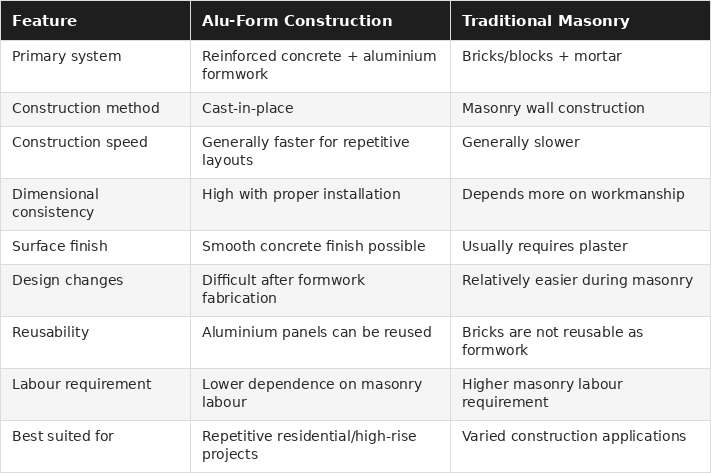
What Are the Advantages of Mivan or Alu-Form Technology?
1. Faster Construction
Pre-engineered panels and repetitive construction cycles can significantly reduce construction time compared with conventional masonry-based processes.
2. Better Dimensional Accuracy
Factory-engineered aluminium panels allow construction teams to maintain consistent dimensions across repetitive units.
3. Smooth Surface Finish
Properly executed aluminium formwork can produce relatively smooth concrete surfaces, reducing the need for conventional plastering in many applications.
However, surface preparation such as putty or other finishing treatments may still be required before painting.
4. Reduced Masonry Work
Because structural walls can be formed and cast in reinforced concrete, the process reduces the amount of conventional brick or block masonry required.
5. Reduced Construction Joints
Casting structural elements together can reduce the number of interfaces between separately constructed components.
6. Reusable Formwork
Aluminium panels can be reused across multiple construction cycles, making them particularly suitable for large projects with repetitive layouts.
7. Consistent Quality
Standardised formwork can reduce dimensional variations and improve consistency when supported by strong quality-control practices.
8. Potentially Higher Usable Area
Because plaster thickness can be reduced or eliminated in applicable areas, the finished wall build-up may be thinner. However, actual carpet-area gains depend on the building’s design and wall specifications.
What are the common problems with Mivan/ AluForm Construction?
While Alu-Form offers several advantages, it is not suitable for every project.
1. Higher Initial Investment
Designing, manufacturing and procuring aluminium formwork can involve substantial upfront costs.
2. Limited Flexibility for Late Design Changes
Once panels have been designed and fabricated, major changes to the floor plan can be difficult and expensive. Also, no part of the wall can be modified at a later stage.
3. Requires Detailed Planning
Openings, electrical conduits, plumbing, and other services must be coordinated before concrete is poured.
4. Skilled Installation Required
Correct panel alignment, reinforcement placement, connections and concrete pouring require trained site teams and effective quality control.
5. Thermal Performance Needs Consideration
Reinforced concrete walls have different thermal properties from conventional masonry. Building design may therefore need appropriate insulation and other measures to achieve desired thermal performance.
6. Repairs Can Be More Complex
Modifications or repairs to reinforced concrete walls can require specialised methods and should be assessed by qualified structural professionals.
Is Alu-Form Construction Earthquake Resistant?
Alu-Form construction can perform well in seismic regions when the building is properly designed, detailed and constructed according to applicable structural and seismic codes.
The key advantage is not aluminium itself. Instead, the system can create reinforced concrete structural walls and other monolithic elements designed to work together as part of the building’s structural system.
However, earthquake resistance depends on factors such as:
- Structural design
- Reinforcement detailing
- Concrete quality
- Foundation design
- Soil conditions
- Building configuration
- Construction quality
- Compliance with relevant seismic codes
Therefore, it is more accurate to say that properly engineered Alu-Form buildings can be designed for seismic performance, rather than claiming that Alu-Form automatically makes a building earthquake-proof.
What Is the Lifespan of an Alu-Form Building?
There is no single fixed lifespan for an Alu-Form building.
Its service life depends on factors such as:
- Structural design
- Concrete quality
- Reinforcement protection
- Construction quality
- Waterproofing
- Environmental exposure
- Maintenance
- Building usage
A well-designed and properly maintained reinforced concrete building can have a long service life comparable to other well-engineered RCC structures.
The use of aluminium formwork itself does not determine the lifespan of the completed building.
What Are the Latest Advancements in Alu-Form Construction?
Aluminium formwork is increasingly being combined with other construction technologies to improve planning, productivity and quality.
Emerging areas include:
- Building Information Modelling (BIM)
- Digital construction planning
- Automated reinforcement processes
- Concrete quality monitoring
- Sensor-based construction monitoring
- Advanced surveying and dimensional control
- Data-driven project management
- More sustainable construction materials
The broader trend is towards industrialised and technology-enabled construction, where design, manufacturing and site execution are increasingly integrated.
Is Alu-Form Technology the Future of Construction?
Alu-Form Technology is an important construction method for projects that require speed, consistency and repetitive construction.
Its ability to combine reinforced concrete construction with reusable, precision-engineered formwork makes it particularly suitable for large residential developments, high-rise buildings and projects with standardised layouts.
However, it is not a universal replacement for every construction method. The right system depends on the project’s design, scale, structural requirements, construction programme, budget and site conditions.
For developers, the real value of Alu-Form lies in its ability to bring precision, repeatability and efficiency to the construction process.
At Modern Spaaces, we believe technology should serve a larger purpose: creating homes that combine thoughtful design, structural quality and long-term value. By embracing modern construction methods, we continue to explore better ways to build homes designed for the way people live today and tomorrow.
Frequently Asked Questions About Alu-Form Technology
1. What is Alu-Form Technology?
Alu-Form Technology is an aluminium formwork construction system used to cast reinforced concrete walls, slabs and other structural elements with high precision and consistency.
2. Is Alu-Form the same as Mivan Technology?
Alu-Form refers broadly to aluminium formwork construction, while Mivan is a brand associated with this technology. In India, the terms are often used interchangeably.
3. What is Alu-Form construction used for?
Alu-Form is commonly used for high-rise apartments, residential developments, mass housing and projects with repetitive floor plans.
4. Is Alu-Form better than brick construction?
Alu-Form offers advantages in construction speed, dimensional accuracy, structural integration and repeatability. However, the most appropriate construction method depends on the project’s design and requirements.
5. Does Alu-Form construction require plastering?
Not necessarily. Properly executed aluminium formwork can produce smooth concrete surfaces that may not require conventional plastering. However, surface preparation such as putty may still be needed before painting.
6. How many times can aluminium formwork be reused?
Aluminium formwork can be reused many times when properly maintained. The actual number of reuses depends on the formwork system, handling, maintenance and site conditions.
7. Is Aluform/Mivan construction earthquake resistant?
Mivan construction can be designed to perform well under seismic loads, but earthquake resistance depends on the complete structural design, reinforcement detailing, materials, foundation and compliance with applicable codes.
8. Is Aluform construction more expensive?
The initial investment in aluminium formwork can be higher than conventional methods. However, faster construction cycles, reusability and reduced masonry-related labour can improve overall project efficiency.
9. Does Aluform increase carpet area?
It can potentially reduce wall thickness and plaster build-up, but the actual impact on carpet area depends on the project’s architectural and structural design.
10. How long does an Aluform building last?
There is no fixed lifespan determined by the formwork system. The longevity of the completed building depends primarily on structural design, construction quality, materials, environmental exposure and maintenance.
Read our Latest Blogs
Why Choose Modern Spaaces: Bangalore’s Fastest-Growing Real Estate Developer

Company Insight
- October 13, 2026
- 13 min read
Bangalore Metro Impact on Property Prices: What Buyers Should Know
Buying & Investing Insights
- October 5, 2026
- 27 min read

15 Packing and Moving Tips in Bangalore for a Stress-Free House Shift
Lifestyle & Design Inspiration
- September 24, 2026
- 24 min read

Explore Projects

Independent 4 & 5 BHK Villas
starts @ 5 Cr


Sarjapur’s Exclusive 3 BHK Community
starts @ 1.8 Cr

Multi-Gen 2 & 3 BHK Homes
Starts @ 1.87 Cr
Refer & Earn Up to 2%

Invite your friends to explore Modern Spaaces and earn up to 2% of the home value they buy.

Find your Dream Home. Let's talk
Tell us a bit about what you're looking for. One of us will get back to you!