GBA vs BBMP: What Bangalore Property Owners Need to Know in 2026

Regulatory & Legal Guide
- August 5, 2026
- 14 min read
Introduction
GBA Vs BBMP: Are you finding the transition difficult to understand? You’re not alone. The Bruhat Bengaluru Mahanagara Palike (BBMP), which has governed Bangalore since 2007, was officially replaced by the Greater Bengaluru Authority (GBA) on 2 September 2025, marking one of the city’s biggest administrative reforms.
As Bangalore has grown rapidly, many areas that were once on the city’s outskirts have become key urban neighbourhoods. To better manage this expansion, the Greater Bengaluru Governance Act introduced a new governance structure
For homeowners, investors and developers, this change raises several important questions.
Will property taxes increase? Are existing A Khata and B Khata documents still valid? Will building approvals or property registrations become more complicated?
In this blog, we’ll explain what the Greater Bangalore Authority is, why it was introduced, and what it means for property owners, homebuyers and the future of Bangalore’s real estate market.
GBA at a Glance
- Replaced: Bruhat Bengaluru Mahanagara Palike (BBMP)
- Legal basis: Greater Bengaluru Governance Act, 2024
- GBA established: 15 May 2025
- BBMP dissolved, GBA operational: 2 September 2025
- Structure: 5 city corporations (North, South, East, West, Central) under one apex authority
- Total wards: 369 (up from 198 under BBMP)
- Chief Commissioner: M. Maheshwar Rao, IAS
- Corporation elections: pending, Supreme Court deadline 31 August 2026
What is the Greater Bangalore Authority (GBA) in Bangalore?
The Greater Bangalore Authority (GBA) is the new governing body responsible for overseeing Bangalore’s metropolitan administration.
Created under the Greater Bangalore Governance Act, the GBA replaces the previous BBMP led system with a more decentralised model designed to improve urban governance, infrastructure planning and civic service delivery.
- Tier 1: The Apex Authority. Chaired by the Chief Minister of Karnataka, this umbrella body oversees unified planning and brings parastatal agencies such as BESCOM, BWSSB and BMRCL under a single coordinating structure.
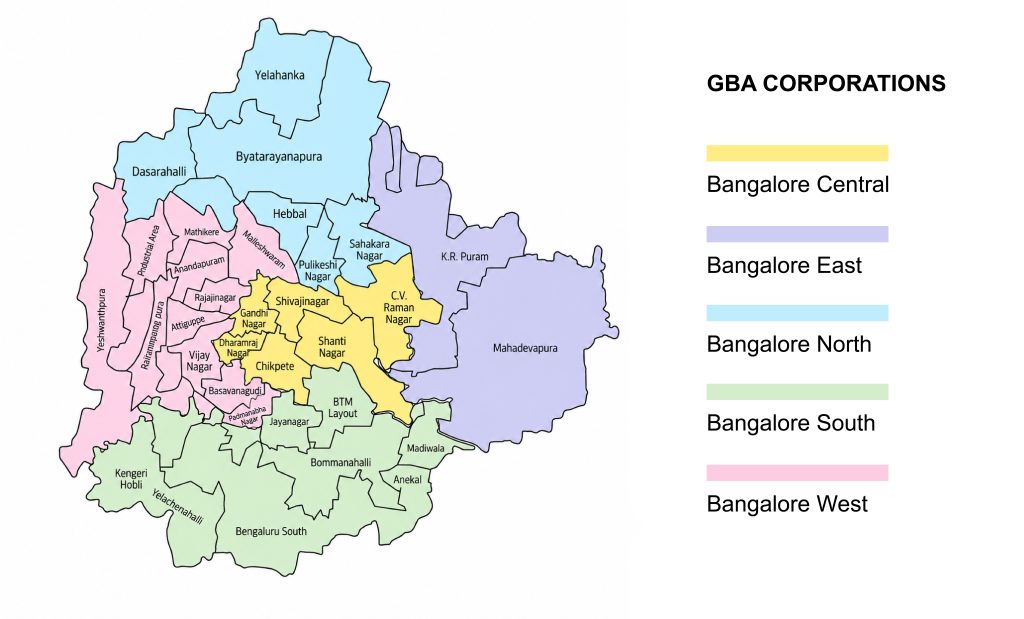
- Tier 2: Five City Corporations. Bangalore is now divided into five distinct corporations, North, South, East, West and Central, each headed by its own Mayor and an IAS Commissioner.
- Tier 3: Empowered Ward Committees. Hyperlocal civic issues are managed by restructured ward committees with stronger citizen representation.
Rather than operating through one large municipal corporation, Bangalore will now be administered by five separate city corporations, each responsible for managing civic services within its jurisdiction:
- Bangalore North
- Bangalore South
- Bangalore East
- Bangalore West
- Bangalore Central
The GBA serves as the supreme coordinating authority, ensuring these corporations work together and collaborating with agencies such as the BDA (Bangalore Development Authority), BWSSB (Bangalore Water Supply and Sewerage Board), BMTC (Bangalore Metropolitan Transport Corporation), and BMRCL (Bangalore Metro Rail Corporation Limited).
This integrated governance model is expected to improve planning across transport, infrastructure, utilities, land use and environmental management.
GBA Vs BBMP
As Bangalore expanded into one of India’s fastest-growing metropolitan cities, governing the entire city through a single municipal corporation became increasingly challenging.
The BBMP served the city for nearly two decades, but rapid population growth, urban expansion and increasing infrastructure demands highlighted the need for a more efficient administrative framework.
The introduction of the Greater Bangalore Authority aims to address these challenges by decentralising governance and improving accountability.
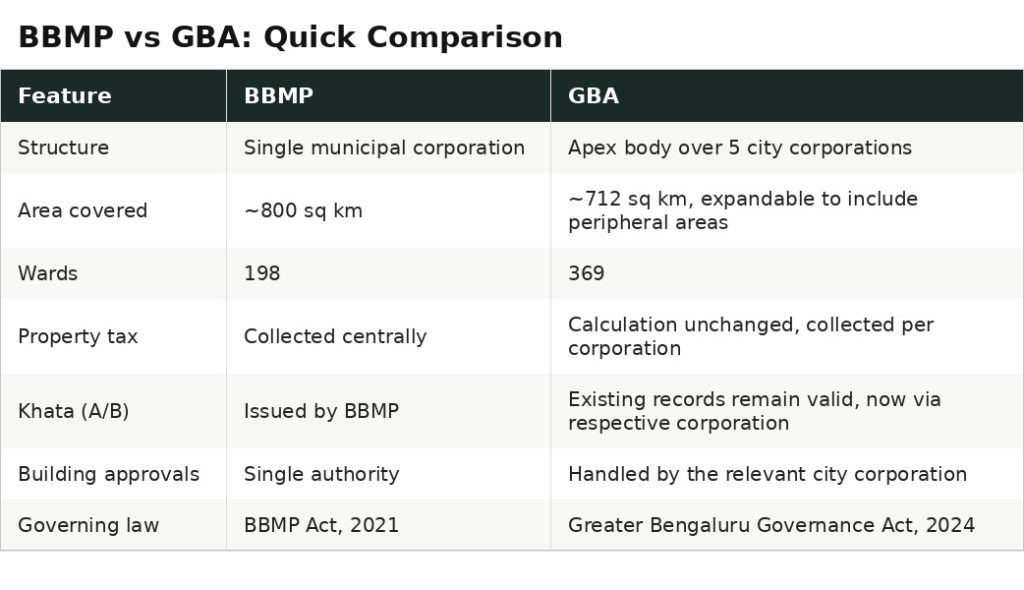
Some of the key reasons behind this transition include:
1. Better Local Governance
Managing a metropolitan population of over 13 million through a single civic body often resulted in administrative delays and slower decision-making.
With five independent city corporations, civic services can now be managed closer to local communities, allowing for quicker responses and improved public service delivery.
2. Improved Coordination Between Government Agencies
One of the biggest challenges under the previous system was coordination between multiple civic agencies.
Roads would often be resurfaced only to be dug up again for water pipelines or utility work due to poor planning between departments.
The GBA has been created to bring these agencies together under a unified planning framework, helping reduce duplication of work and improve project execution.
3. Faster Infrastructure Planning
Major infrastructure projects such as roads, metro expansion, drainage systems and public utilities require collaboration across multiple government departments.
The GBA is expected to streamline planning and implementation by enabling better coordination between civic authorities and infrastructure agencies.
4. Stronger Local Accountability
Each city corporation will now have greater responsibility for managing its own jurisdiction.
This decentralised approach is intended to improve transparency, accountability and the overall quality of civic administration.
GBA Map
How Does the GBA Affect Property Owners?
For most property owners, the transition to the Greater Bangalore Authority will be largely administrative.
There are no immediate changes to property ownership, registrations or existing property documents. However, some civic services will gradually shift to the newly formed city corporations.
Here’s what you should know.
1. Property Tax Collection
Property tax remains one of the most important sources of revenue for Bangalore’s civic administration.
While the method of calculating property tax remains unchanged, tax collection will now be managed by the relevant city corporation rather than a single central authority.
For example, if your property falls within Bangalore East, future tax administration will be handled by the Bangalore East City Corporation.
As these corporations become financially independent, greater emphasis is expected to be placed on accurate assessments, efficient collection and regular audits.
Property owners should therefore continue paying taxes on time and ensure their property details remain accurate.
2. A Khata and B Khata Documents Continue to Remain Valid
One of the biggest concerns among homeowners has been whether existing Khata documents will become invalid following the introduction of the GBA.
The answer is no.
Existing A Khata and B Khata records remain fully valid.
The transition primarily involves shifting property databases from the former BBMP system to the respective city corporations.
Property ownership, Khata status and tax records remain unchanged during this migration.
Homeowners applying for Khata transfers, name changes or e-Khata services may simply interact with their respective city corporation instead of the earlier BBMP offices once the transition is complete.
3. Building Approvals and Occupancy Certificates
Building plan approvals, Occupancy Certificates (OCs) and construction compliance will now fall under the jurisdiction of the respective city corporation where the property is located.
Although the approval process itself remains broadly similar, local corporations will be responsible for reviewing applications, monitoring compliance and issuing approvals.
This decentralised system is expected to improve efficiency by reducing the administrative burden on a single civic authority.
4. Ward Governance Will Become More Localised
One of the most significant outcomes of the Greater Bangalore Governance Act is the decentralisation of civic administration.
Under the previous BBMP structure, Bangalore was divided into 198 wards managed by a single municipal corporation. With the introduction of the GBA, the city has been reorganised into 369 wards across five independent city corporations.
The objective is to bring governance closer to residents by reducing the administrative burden on a single civic body. Smaller jurisdictions are expected to make civic services more responsive, improve public grievance redressal, and enable faster decision-making at the local level.
For property owners, this means future interactions related to civic services, tax payments, Khata updates and approvals will be handled by the corporation responsible for their property’s jurisdiction.
Will Property Tax, Khata or Building Approvals Change Immediately?
No. The transition from BBMP to GBA is being carried out in phases to minimise disruption to property owners.
At present:
- Existing A Khata and B Khata documents remain valid.
- Property ownership records remain unchanged.
- The current method of calculating property tax continues to apply.
- Existing online services and property databases will continue functioning while records are migrated to the new corporations.
In other words, homeowners are not required to obtain new Khata documents or re-register their properties simply because the administrative structure has changed.
The primary difference is that, over time, civic services will be managed by the relevant city corporation rather than a centralised BBMP.
Key Things Bangalore Property Owners Should Watch in 2026
Although the transition is designed to be seamless, property owners should remain proactive during this period. Keeping your property records up to date will help avoid delays in future transactions or approvals.
1. Know Your New Jurisdiction
With Bangalore now governed through five city corporations, it’s important to know which corporation your property falls under. This determines where you’ll pay property tax, apply for Khata services, obtain building approvals, and raise civic service requests. As the city’s boundaries have been redrawn, several newly included areas are now part of the Greater Bengaluru region, making it essential to verify your property’s jurisdiction.
2. Verify Your Property Tax Records
As property records are migrated to the new administrative system, review your tax details carefully.
Ensure that information such as survey numbers, property dimensions, ownership details and payment history has been transferred accurately. Identifying discrepancies early can help avoid complications later.
3. Check Your Digital Khata Records
Property owners should periodically verify that their e-Khata information has been updated correctly in the new database.
Pay particular attention to:
- Owner name
- Survey number
- Property dimensions
- Property classification
- Khata number
Accurate records are especially important if you intend to sell, purchase or finance a property.
4. Ensure Your Property Is Legally Compliant
The decentralised governance model is expected to strengthen compliance monitoring across the city.
If your property requires a building plan approval, Occupancy Certificate (OC) or any other statutory approval, ensure all documents are in order.
This is particularly important for new developments, independent homes and properties undergoing renovation or extension.
5. Stay Updated on Civic Service Platforms
As the new corporations become operational, service portals and grievance redressal systems may gradually shift to corporation-specific platforms.
Keeping track of these updates will make it easier to access services such as:
- Property tax payments
- Khata applications and transfers
- Building approvals
- Trade licences
- Civic complaints
6. Apartment Associations Should Stay Informed
Resident Welfare Associations (RWAs) and apartment associations should monitor changes in civic administration within their jurisdiction.
Service responsibilities relating to waste management, road maintenance, public utilities and local taxes may gradually transition to the respective city corporation, making it important for associations to understand the new administrative framework.
“Homebuyers and property owners can be reassured that the GBA transition does not alter the validity of their ownership documents. Instead, it lays the foundation for improved coordination, faster civic processes, and a more efficient regulatory environment.”
What Should Property Owners Do Now?
The introduction of the Greater Bangalore Authority does not require immediate action from property owners. However, maintaining organised and accurate records will help ensure a smooth transition as the new governance structure is implemented.
Elections to the five city corporations have been repeatedly delayed and are now due by 31 August 2026 under a Supreme Court order, the final extension the court has said it will grant. Property owners should watch for the outcome, as elected mayors and councils will eventually take over from the current IAS administrators.
Here are a few practical steps to consider:
Keep Your Property Documents Organised
Maintain both physical and digital copies of important documents, including:
- Sale deed
- Khata certificate and extract
- Encumbrance Certificate (EC)
- Property tax receipts
- Building plan approvals
- Occupancy Certificate (if applicable)
Having these readily available can simplify future transactions and administrative processes.
Ensure Property Details Are Accurate
Review your property records to confirm that the built-up area, usage type and ownership details are correctly reflected.
Any discrepancies should be addressed promptly to avoid issues during tax assessments or future property transactions.
Track Official Announcements
As the transition progresses, continue referring to official notifications issued by the Greater Bangalore Authority and your respective city corporation for updates on services, jurisdictional boundaries and administrative procedures.
Complete Pending Approvals
If your property requires approvals such as a building plan sanction, Occupancy Certificate or utility connections, ensure these are completed in accordance with the applicable regulations.
Keeping your property legally compliant will make future resale, financing and ownership transfers significantly easier.
What Happens to Gram Panchayat Areas Under the GBA?
One of the biggest questions surrounding the introduction of the Greater Bangalore Authority (GBA) is what it means for properties that were previously governed by Gram Panchayats.
As Bangalore continues to expand, several villages and peri-urban areas that local Gram Panchayats once administered are gradually being brought within the city’s urban governance framework. While the creation of the GBA does not automatically convert every Gram Panchayat area into municipal limits overnight, it provides a more structured governance model for areas that are notified for inclusion as Bangalore grows.
Will Gram Panchayat Properties Become Municipal Properties?
Properties located in areas that are officially incorporated into one of the five new city corporations will eventually come under urban municipal administration. Once this transition takes place, civic services such as property tax collection, building plan approvals and Khata-related services will be managed by the respective city corporation instead of the Gram Panchayat.
However, the transition is not automatic and depends on official government notifications. Until an area is formally included within the jurisdiction of a city corporation, the existing Gram Panchayat administration and its records continue to remain valid.
What Does This Mean for Property Owners?
For homeowners and buyers in Bangalore’s rapidly developing outskirts, the transition could bring several long-term benefits:
- Improved civic infrastructure and municipal services.
- Standardised property tax administration under the city corporation.
- Better access to urban utilities, including roads, drainage and waste management.
- Greater clarity in planning regulations and development approvals.
- Increased confidence among banks and financial institutions when evaluating properties in newly urbanised areas.
Conclusion
The transition from BBMP to the Greater Bangalore Authority marks one of the most significant reforms in Bangalore’s urban governance in recent years.
While the administrative structure has changed, the fundamentals of property ownership remain the same. Existing Khata records continue to be valid, property tax calculations remain unchanged, and there is no requirement for homeowners to obtain fresh documentation solely because of the transition.
The long-term objective of the GBA is to create a more efficient, decentralised system capable of supporting Bangalore’s continued growth. By distributing civic responsibilities across five city corporations, the new framework aims to improve service delivery, strengthen infrastructure planning and enhance accountability at the local level.
For property owners, the best approach is to stay informed, maintain accurate property records and follow updates issued by the relevant city corporation. Taking these simple steps today can help ensure a smoother experience as Bangalore’s new governance model continues to evolve.
FAQs (Frequently Asked Questions)
1. What is the Greater Bangalore Authority (GBA)?
The Greater Bangalore Authority (GBA) is the new governing body established under the Greater Bangalore Governance Act to oversee Bangalore’s urban administration. It replaces the BBMP’s single-corporation model with five decentralised city corporations—North, South, East, West and Central Bangalore, to improve governance, infrastructure planning and civic service delivery.
2. Why did the GBA replace BBMP?
BBMP was replaced to improve the efficiency of Bangalore’s civic administration. As the city expanded rapidly, managing all civic services through a single municipal corporation became increasingly challenging. The GBA introduces a decentralised governance model to enable better coordination, faster decision-making and improved public services.
3. Will my existing A Khata or B Khata become invalid after the GBA transition?
No. Existing A Khata and B Khata documents remain valid. The introduction of the GBA changes the administrative structure but does not affect the legal validity of existing property records or ownership documents.
4. Will property tax rules change under the GBA?
The method of calculating property tax remains unchanged. However, tax collection and administration will gradually be handled by the respective city corporation under whose jurisdiction your property falls.
5. What happens to properties in Gram Panchayat areas?
Properties located in Gram Panchayat areas will continue to be governed by the respective Gram Panchayat unless the area is officially brought under one of the GBA’s city corporations through a government notification. Once incorporated, civic services, property tax administration and Khata-related services will be managed by the relevant city corporation.
6. Will a Gram Panchayat Khata automatically become an A Khata?
No. A Gram Panchayat Khata does not automatically convert into an A Khata when an area comes under municipal limits. Property owners must comply with the applicable regulations and complete the required procedures, if any, as prescribed by the local authority.
7. How can I check if my property falls under the GBA?
You can verify your property’s jurisdiction through official notifications issued by the Karnataka Government or the respective city corporation. It’s also advisable to consult the local revenue or municipal office before buying or selling a property.
8. Will building approvals and Occupancy Certificates be affected?
Building plan approvals, Occupancy Certificates (OCs) and other construction-related approvals will now be processed by the respective city corporation responsible for your property’s jurisdiction. The approval process remains largely the same, although the administrative authority may change.
9. Do I need to update my property documents because of the GBA?
No. Property owners are not required to obtain new Khata certificates or other ownership documents solely because of the transition from BBMP to the GBA. Existing records remain valid unless otherwise notified by the authorities.
10. What should homebuyers verify before purchasing property in Bangalore?
Before purchasing a property, verify:
- The property’s governing authority (City Corporation or Gram Panchayat).
- Khata status and ownership records.
- Building approvals and Occupancy Certificate (if applicable).
- Property tax payment history.
- Whether the property complies with applicable planning and zoning regulations.
Read our Latest Blogs
GBA vs BBMP: What Bangalore Property Owners Need to Know in 2026

Regulatory & Legal Guide
- August 5, 2026
- 25 min read

Homes in All Sizes: Bangalore Living for Every Budget and Family
Featured Property
- August 5, 2026
- 21 min read

Green Storeys: Boutique 2 & 3 BHK Homes Off Sarjapur Road Designed for Light, Ventilation and Green Living
Featured Property
- July 30, 2026
- 10 min read

Explore Projects


Independent 4 & 5 BHK Villas
starts @ 4.5 Cr


Sarjapur’s Exclusive 3 BHK Community
starts @ 1.8 Cr

Multi-Gen 2 & 3 BHK Homes
Starts @ 1.87 Cr
Refer & Earn Up to 2%
Invite your friends to explore Modern Spaaces and earn up to 2% of the home value they buy.

Find your Dream Home. Let's talk
Tell us a bit about what you're looking for. One of us will get back to you!