
RERA Terms and Definitions Every Homebuyer in Karnataka Should Know

Regulatory & Legal Guide
- August 28, 2026
- 14 min read
Introduction
Buying a home involves much more than choosing the right location, floor plan and budget. Once you start reviewing property documents, advertisements and project details, you may come across terms such as allottee, promoter, carpet area, Agreement for Sale, sanctioned plan, Completion Certificate (CC), Occupancy Certificate (OC) and RERA registration.
For a first-time homebuyer, these terms can feel complicated. Understanding them, however, can make it easier to evaluate a property, read important documents and ask the right questions before making a purchase.
The Real Estate (Regulation and Development) Act, 2016, commonly known as RERA, established a regulatory framework for applicable real estate projects and real estate agents. It aims to promote transparency, accountability and consumer protection in the real estate sector.
But what do these RERA terms actually mean?
In this blog, we explain the key RERA terms and definitions every homebuyer should know, what the Act says in simple language, and why each term matters when you’re buying a property in Karnataka.
Quick note: Some terms discussed below are formal definitions under Section 2 of the RERA Act, while others are important requirements, rights or protections created by different sections of the Act. They are grouped together because they are all relevant to a homebuyer’s property purchase.
RERA vs KRERA: What Is the Difference?
Before getting into the terminology, it helps to understand the difference between RERA and KRERA, particularly if you’re buying property in Karnataka.
The Real Estate (Regulation and Development) Act, 2016, commonly known as RERA, is a central law that establishes the regulatory framework for the real estate sector across India. States and Union Territories implement the applicable framework through their respective regulatory authorities.
In Karnataka, the state-level authority is commonly referred to as KRERA (Karnataka Real Estate Regulatory Authority).
What Is RERA?
RERA is the central legislation that establishes rules and protections relating to applicable real estate projects, promoters, allottees and real estate agents. It aims to improve transparency, accountability and consumer protection in the real estate sector.
What Is KRERA?
KRERA refers to the Karnataka Real Estate Regulatory Authority, which administers the applicable RERA framework in Karnataka.
For a homebuyer purchasing property in Karnataka, KRERA can therefore be an important source for checking applicable project and promoter information.
Comparison between RERA & KRERA
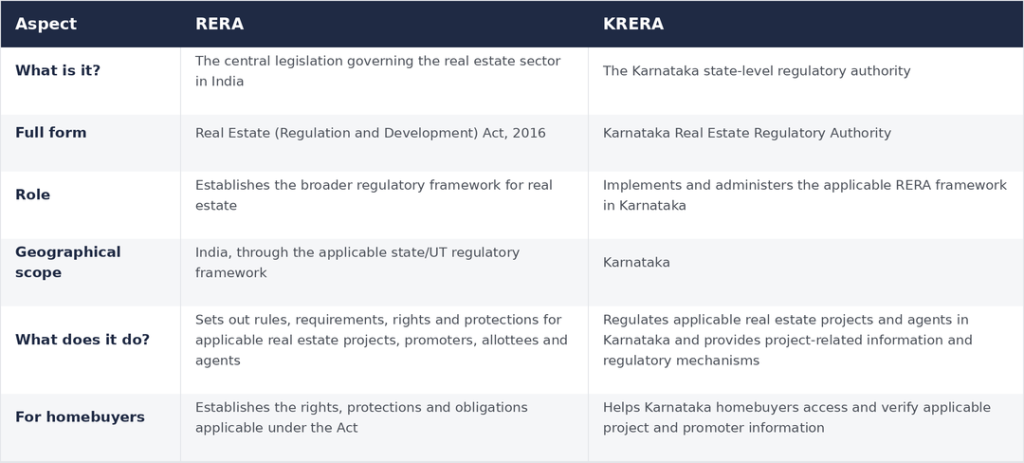
In simple terms: RERA is the law, while KRERA is Karnataka’s regulatory authority that administers the applicable RERA framework in the state.
RERA Terms at a Glance
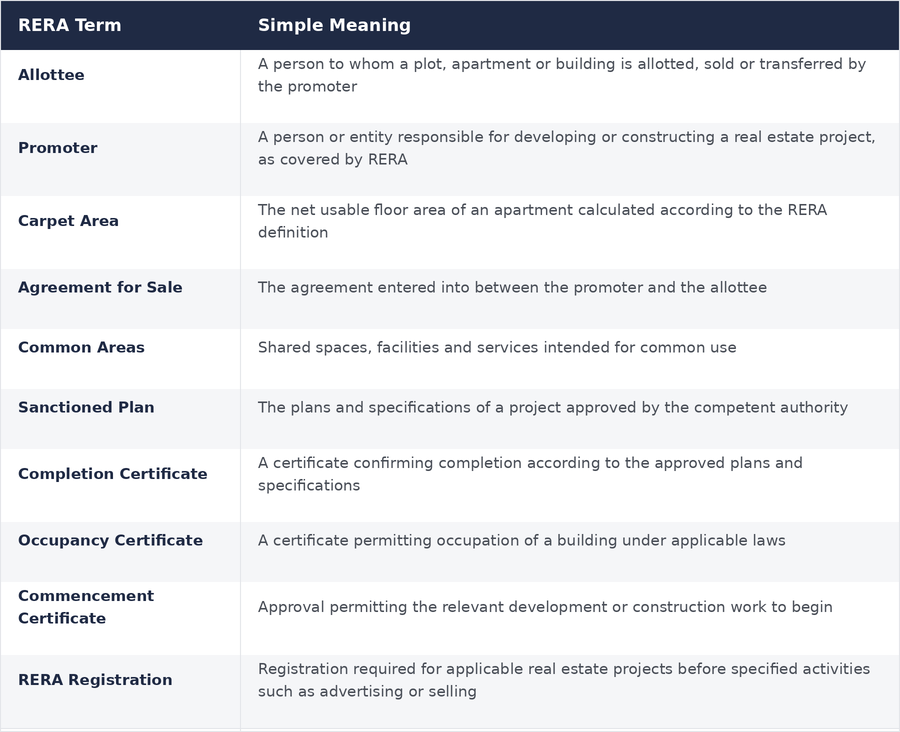
Key RERA Terms and Definitions Every Homebuyer in Karnataka Should Know
Not every important RERA concept is a definition under Section 2. The terms below include important definitions that homebuyers may encounter while reviewing property documents.
What Is an Advertisement Under RERA?
Under RERA:
Section 2(b) broadly covers communications used to promote a real estate project or offer a plot, apartment or building for sale, including communications made through different forms of media.
In simple words:
An advertisement isn’t limited to a newspaper ad or printed brochure. Websites, digital advertisements, social media promotions and other forms of communication can also be used to promote a property.
Why does it matter?
As a homebuyer, pay attention to what a project promises in its marketing material. It’s worth comparing those claims with the project’s official RERA disclosures and documents before making a decision.
What Is an Agreement for Sale Under RERA?
Under RERA:
Section 2(c) defines an Agreement for Sale as the agreement entered into between the promoter and the allottee.
In simple words:
Think of the Agreement for Sale as the formal contract between you and the developer. It sets out the terms of the property transaction and the responsibilities of both parties.
Why does it matter?
This is one of the most important documents you’ll sign during the homebuying process. Before signing, check details such as the property’s description, carpet area, payment schedule, possession terms, specifications, and other obligations.
Who Is an Allottee Under RERA?
Under RERA:
Section 2(d) defines an allottee as a person to whom a plot, apartment, or building has been allotted, sold, or otherwise transferred by the promoter. It can also include someone who subsequently acquires that allotment through sale, transfer or otherwise. A person who receives the property only on rent is excluded.
In simple words:
If a developer has allotted or sold you a home, plot or building, you will generally be considered an allottee under RERA. Simply renting a property does not make someone an allottee.
Why does it matter?
RERA gives allottees specific rights and responsibilities. Understanding this term helps you understand where you stand in a property transaction.
What Is an Apartment Under RERA?
Under RERA:
Section 2(e) uses “apartment” broadly to refer to a separate and self-contained part of immovable property intended for residential, commercial, professional or other permitted uses.
In simple words:
An apartment under RERA doesn’t necessarily mean only a residential flat. Depending on the property, the term can also cover units such as offices, shops and showrooms.
Why does it matter?
This broad definition allows RERA terminology to apply to different types of real estate units and not just residential apartments.
What Is the Real Estate Appellate Tribunal?
Under RERA:
Section 2(j) refers to the Appellate Tribunal established under Section 43 of the Act.
In simple words:
The Real Estate Appellate Tribunal is the body that hears eligible appeals against certain decisions, directions or orders issued under the RERA framework.
Why does it matter?
It provides a statutory mechanism for parties to challenge decisions covered by RERA’s appeal process.
What Is the RERA Authority?
Under RERA:
Section 2(i) refers to the Real Estate Regulatory Authority established under Section 20 of the Act.
In simple words:
The RERA Authority is the regulatory body responsible for implementing RERA in the relevant state or Union Territory.
Why does it matter?
The Authority performs important functions such as project and real estate agent registration, regulatory oversight and other functions assigned under the Act.
What Is a Building Under RERA?
Under RERA:
Section 2(j) covers a structure or part of a structure intended for residential, commercial, business, professional or other specified uses.
In simple words:
For RERA purposes, “building” is a broad term and isn’t restricted to residential buildings.
Why does it matter?
Understanding the term helps clarify the types of structures and developments covered by RERA terminology.
What Is Carpet Area Under RERA?
Under RERA:
Section 2(k) defines carpet area based on the usable floor area of an apartment and specifically identifies which areas are excluded and which are included.
In simple words:
Think of carpet area as the usable floor space inside your apartment. Your exclusive balcony, verandah and open terrace aren’t counted, nor are external walls and service shafts. However, the area occupied by internal partition walls is included.
Why does it matter?
Carpet area gives you a more consistent way to compare apartment sizes. When evaluating a home, don’t look only at the advertised super built-up area. Check the RERA carpet area as well.
What Is a Commencement Certificate Under RERA?
Under RERA:
Section 2(m) refers to a commencement certificate, building permit or construction permit issued by the competent authority that allows development work to begin in accordance with the sanctioned plan.
In simple words:
It is essentially the permission that allows the developer to start the relevant construction or development work, subject to applicable requirements.
Why does it matter?
If you’re buying an under-construction property, checking whether the required approvals have been obtained is an important part of property due diligence.
What Are Common Areas Under RERA?
Under RERA:
Section 2(n) covers various areas and facilities intended for common use within a real estate project, including specified shared spaces, services and facilities.
In simple words:
Common areas are the parts of a project that aren’t meant exclusively for one homeowner. Think of spaces such as lobbies, lifts, staircases, parks and other shared facilities.
Why does it matter?
Understanding common areas helps you distinguish between the space that belongs to your individual apartment and the facilities shared by residents.
What Is a Completion Certificate Under RERA?
Under RERA:
Section 2(q) refers to a certificate issued by the competent authority confirming that the real estate project has been completed according to the approved plans, layout and specifications.
In simple words:
A Completion Certificate essentially confirms that the completed project corresponds with the plans and specifications approved by the relevant authority.
Why does it matter?
It is an important document when assessing whether a project has been completed in accordance with its approved plans.
What Is an Occupancy Certificate Under RERA?
Under RERA:
Section 2(zf) refers to an Occupancy Certificate as a certificate issued by the competent authority permitting occupation of a building under applicable local laws and providing for the required civic infrastructure.
In simple words:
An Occupancy Certificate (OC) is essentially the approval that permits a building to be occupied under the applicable regulations.
Why does it matter?
For a homebuyer, the OC matters because it directly relates to whether the building can be occupied under applicable laws.
Who Is a Promoter Under RERA?
Under RERA:
Section 2(zk) covers a person or entity involved in developing or constructing a real estate project or developing land for sale, along with other entities covered by the statutory definition.
In simple words:
A promoter is broadly the person or organisation responsible for developing a real estate project and offering its properties for sale.
Why does it matter?
RERA places several responsibilities on promoters, including requirements relating to registration, disclosures, agreements and project development.
What Is a Real Estate Agent Under RERA?
Under RERA:
Section 2(zm) covers a person who negotiates or acts on behalf of another person in connection with the sale or purchase of a plot, apartment or building in a real estate project.
In simple words:
A real estate agent is essentially an intermediary who helps facilitate a property transaction.
Why does it matter?
RERA provides for the registration of real estate agents dealing with applicable registered projects. Buyers can check an agent’s registration details with the relevant RERA authority.
What Is a Real Estate Project Under RERA?
Under RERA:
Section 2(zn) covers developments such as construction of buildings, conversion of existing buildings into apartments and development of land into plots or apartments for sale, subject to the definition in the Act.
In simple words:
A real estate project isn’t limited to a new apartment complex. Depending on the development, it can include apartments, plots and certain building conversion or development projects.
Why does it matter?
Understanding what qualifies as a real estate project helps you determine when RERA’s project registration framework may apply.
What Is a Sanctioned Plan Under RERA?
Under RERA:
Section 2(zq) refers to plans and specifications relating to a real estate project that have been approved by the competent authority. These can include site, building, layout, parking, landscape and other relevant project plans.
In simple words:
Think of sanctioned plans as the project’s officially approved blueprint. They cover much more than just the floor plan of your apartment.
Why does it matter?
They help you understand what has actually been approved for the development and provide an important reference when evaluating the project.
Important RERA Provisions and Rules Homebuyers Should Know
Not every important RERA concept is a definition under Section 2. Some are requirements or protections created by specific sections of the Act. These are equally important for homebuyers.
What Is RERA Project Registration?
What does RERA say?
Under Section 3, a promoter generally cannot advertise, market, book, sell or offer for sale a plot, apartment or building in an applicable real estate project without registering the project with the relevant RERA Authority. The Act also provides specific exemptions.
In simple words:
If a project falls under RERA’s registration requirements, the developer needs to register it with the relevant authority before carrying out the activities covered by Section 3.
Why does it matter?
RERA registration gives buyers access to important information about the project and its promoter. Checking the registration details is therefore an important step before purchasing a property.
How to Check RERA Registration in Karnataka
Before purchasing a property, homebuyers should check whether the project is registered with the applicable RERA authority and review the information available for the project.
For a property in Karnataka, buyers can check the project’s KRERA registration details, including information relating to the project, promoter and applicable disclosures.
What Should You Check?
- Project name and registration number
- Promoter details
- Project location
- Approved plans and project details
- Declared completion timeline
- Project specifications
- Litigation or other disclosed information, where applicable
- Details of the project’s approvals and disclosures
Why does it matter?
Checking the project’s RERA information can help you compare the developer’s claims with the information officially disclosed for the project.
What Is the 10% Advance Payment Rule Under RERA?
What does RERA say?
Under Section 13 of RERA, a promoter cannot accept more than 10% of the cost of an apartment, plot or building as an advance payment or application fee without first entering into a written Agreement for Sale and registering it as required by law.
In simple words:
A promoter generally cannot ask a buyer to pay more than 10% of the property’s cost as an advance or application fee before entering into the required Agreement for Sale.
Why does it matter?
Before making substantial payments towards a property, buyers should understand the Agreement for Sale and the terms governing the transaction.
What Is the RERA Separate Account?
What does RERA say?
Section 4 requires a promoter to deposit 70% of the amounts realised from allottees from time to time into a separate account in a scheduled bank for the purposes specified under the Act.
In simple words:
A significant portion of the money collected from buyers must be kept in a separate account and used for the project’s land and construction costs, subject to RERA’s conditions.
Why does it matter?
The provision is intended to bring greater financial discipline to project funds and help ensure that money collected for a project is used for specified project costs.
Important: The Act uses the term “separate account.” “RERA escrow account” is a commonly used industry expression, but it isn’t the terminology used in the Act.
What Is the Defect Liability Period Under RERA?
What does RERA say?
Section 14(3) protects certain structural defects and other specified defects in workmanship, quality, provision of services, or other obligations under the Agreement for Sale when they are brought to the promoter’s notice within five years from the date of handing over possession.
In simple words:
If you discover a qualifying defect after taking possession, RERA provides a statutory mechanism for asking the promoter to rectify it.
Why does it matter?
The promoter must rectify qualifying defects without further charge within 30 days of receiving notice, subject to the Act. This gives homebuyers an important post-possession protection.
What Is Force Majeure Under RERA?
What does RERA say?
Section 6 refers to events such as war, flood, drought, fire, cyclone, earthquake or other natural calamities that affect the regular development of a real estate project.
In simple words:
Force majeure refers to certain serious events beyond normal control that can disrupt a project’s development. It does not mean that every unexpected delay automatically qualifies.
Why does it matter?
Force majeure can be relevant when considering an extension of project registration. Buyers should therefore look at the specific circumstances rather than assuming that every project delay falls under force majeure.
What Does RERA Say About Interest on Default?
What does RERA say?
RERA establishes provisions governing interest payable by promoters or allottees in circumstances covered by the Act.
In simple words:
If a buyer or promoter defaults in a situation where RERA requires interest to be paid, the Act provides the applicable interest framework.
Why does it matter?
RERA establishes a principle that the rate of interest chargeable from an allottee for default should correspond to the rate payable by the promoter in the relevant situation.
What Are the Rights of a Homebuyer Under RERA?
RERA provides allottees with several rights relating to project information, possession, common areas and certain remedies in case of non-compliance.
Right to Project Information
Homebuyers are entitled to information relating to sanctioned plans, layout plans, specifications and other information provided under the Act, rules, regulations and Agreement for Sale.
Right to Know the Project Timeline
An allottee is entitled to know the stage-wise schedule for completion of the project, including agreed provisions for essential services and amenities.
Right to Claim Possession
An allottee is entitled to claim possession of the apartment, plot or building in accordance with the applicable provisions and the Agreement for Sale.
Right to Refund in Certain Circumstances
Where the promoter fails to complete or provide possession in accordance with the Agreement for Sale or in certain other circumstances covered by Section 18, the allottee may have a right to withdraw and seek return of amounts with applicable interest and compensation. If the allottee does not withdraw, the Act provides for interest for the period of delay, subject to its provisions.
How Can a Homebuyer File a RERA Complaint in Karnataka?
If a homebuyer has a grievance relating to an applicable real estate project, promoter or real estate agent, RERA provides a mechanism for filing complaints before the appropriate regulatory authority or adjudicating officer, depending on the nature of the matter.
For a Karnataka property, buyers should refer to the applicable KRERA complaint process, requirements and forms before filing.
Before Filing a Complaint
Keep relevant documents such as:
- Agreement for Sale
- Booking or allotment documents
- Payment receipts
- RERA registration details
- Correspondence with the promoter
- Possession-related communications
- Relevant project documents
- Photographs or other supporting evidence, where applicable
Why does it matter?
Keeping a clear record of the transaction can make it easier to establish the facts and support a complaint where required.
Other Property Terms Homebuyers Should Know
Not every term you encounter during a property transaction is a definition under RERA.
Terms such as Khata, Sale Deed, Joint Development Agreement (JDA) and maintenance charges are commonly used in property transactions, but they should not be presented as official RERA definitions.
Understanding them can still be useful when buying a home, particularly when reviewing property documents and carrying out due diligence.
What Is a Khata?
In simple words:
A Khata is a municipal property record associated with the assessment and taxation of a property by the relevant local authority.
Why does it matter?
Khata-related records can be important for property taxation and municipal purposes. However, a Khata should not automatically be treated as conclusive proof of legal title or ownership. Buyers should independently verify title and other relevant property documents.
What Is a Sale Deed?
In simple words:
A Sale Deed is a legal document through which ownership of a property is transferred from the seller to the buyer, subject to applicable laws and registration requirements.
Why does it matter?
It is an important document in recording the transfer of ownership and should be carefully reviewed as part of property due diligence.
What Is a Joint Development Agreement?
In simple words:
A Joint Development Agreement (JDA) is an arrangement between a landowner and developer for developing a property. The agreement sets out the responsibilities, rights, sharing arrangements and other terms agreed between the parties.
Why does it matter?
If you’re purchasing a property developed under a JDA, understanding who owns the land and who is responsible for development can be an important part of your due diligence.
What Are Maintenance Charges?
In simple words:
Maintenance charges are amounts collected for maintaining and managing common areas, facilities and services within a property or residential development.
Why does it matter?
Maintenance costs can form part of your ongoing homeownership expenses. Before buying, understand what is included in the maintenance charges and how they are calculated.
RERA Homebuyer Checklist
Before purchasing an applicable RERA-registered property in Karnataka, consider checking:
- RERA registration details
- Promoter details
- RERA registration number
- Project location and details
- Sanctioned plans
- Carpet area
- Agreement for Sale
- Possession timeline
- Completion Certificate
- Occupancy Certificate, where applicable
- Project specifications
- Common areas and facilities
- Payment schedule
- Relevant project disclosures
- Applicable approvals and permissions
Checking these details can help you understand what is being offered, what has been approved and what obligations exist between you and the promoter.
Why Should Homebuyers Understand RERA Terms?
You don’t need to be a real estate lawyer to understand the basics of RERA.
Knowing important RERA terms and definitions can help you:
- Read property documents with greater clarity
- Understand your Agreement for Sale
- Compare apartment sizes using RERA carpet area
- Check a project’s RERA registration
- Understand important approvals and certificates
- Distinguish between private and common areas
- Understand important promoter obligations
- Identify documents that require further verification
- Make more informed property decisions
For developers and real estate agents, understanding RERA terminology is equally important for regulatory compliance and transparent communication with buyers.
Conclusion
Understanding RERA terms and definitions can make property documents much easier to navigate, especially when you’re buying a home for the first time.
Terms such as allottee, promoter, carpet area, Agreement for Sale, common areas, sanctioned plan, Completion Certificate and Occupancy Certificate are more than legal terminology. Understanding what they mean can help you ask better questions and assess the information provided about a property.
For homebuyers in Karnataka, it is also important to understand KRERA, RERA registration, project disclosures and the rights available under the RERA framework.
Before purchasing a property, check the applicable RERA registration details, review the Agreement for Sale, understand the approved plans and relevant certificates, and carry out appropriate property due diligence.
A little clarity before you buy can help you understand your documents, identify what needs further verification and make a more informed property decision.
FAQs (Frequently Asked Questions)
What Is RERA in Simple Words?
RERA, or the Real Estate (Regulation and Development) Act, 2016, is a central law that establishes a regulatory framework for the real estate sector, promotes transparency and protects consumer interests.
What Is KRERA?
KRERA refers to the Karnataka Real Estate Regulatory Authority, which administers the applicable RERA framework in Karnataka.
What Is an Allottee Under RERA?
An allottee is a person to whom a plot, apartment or building has been allotted, sold or otherwise transferred by the promoter. A person who receives the property only on rent is excluded from this definition.
What Is Carpet Area Under RERA?
Carpet area is the net usable floor area of an apartment calculated according to RERA’s definition. Specified areas such as external walls, service shafts and exclusive balconies are excluded, while internal partition walls are included.
What Is a Promoter Under RERA?
A promoter is broadly the person or entity responsible for developing or constructing a real estate project or developing land for sale, as covered by the Act.
What Is an Agreement for Sale Under RERA?
An Agreement for Sale is the agreement entered into between the promoter and the allottee and sets out the terms of their property transaction.
What Is the RERA Defect Liability Period?
RERA provides five years from the date of handing over possession for certain structural and other specified defects to be brought to the promoter’s notice, subject to Section 14(3).
What Is the RERA Separate Account?
It is the separate account into which RERA requires 70% of the amounts realised from allottees for an applicable project to be deposited, subject to the requirements of the Act.
Is RERA Registration Mandatory for Every Real Estate Project?
No. The Act provides specific exemptions from registration. Whether a particular project requires registration depends on the applicable provisions of RERA and relevant state or Union Territory rules.
How Can I Check RERA Registration in Karnataka?
For a property in Karnataka, homebuyers can check the project’s applicable KRERA registration details, including information about the project, promoter and relevant disclosures.
What Is the 10% Advance Payment Rule Under RERA?
Under Section 13, a promoter cannot accept more than 10% of the cost of an apartment, plot or building as an advance payment or application fee without first entering into the required Agreement for Sale and registering it as required by law.
What Happens If a RERA Project Is Delayed?
Depending on the circumstances covered by Section 18, an allottee may have the right to withdraw and seek a refund with applicable interest and compensation, or continue with the project and receive applicable interest for the period of delay.
What Rights Does a Homebuyer Have Under RERA?
RERA provides allottees with rights relating to project information, completion timelines, possession, common areas and certain remedies in cases of non-compliance.
What Is the Difference Between a Completion Certificate and an Occupancy Certificate?
A Completion Certificate relates to completion of the project according to the sanctioned plans and specifications. An Occupancy Certificate relates to permission to occupy a building under applicable local laws.
What Is the Difference Between Carpet Area and Super Built-Up Area?
Carpet area is specifically defined under RERA. Super built-up area is a commonly used industry term that may include the apartment area along with a proportionate share of common areas and facilities.
Since RERA specifically defines carpet area, buyers should pay close attention to the declared RERA carpet area when comparing properties.
Read our Latest Blogs
RERA Terms and Definitions Every Homebuyer in Karnataka Should Know

Regulatory & Legal Guide
- August 28, 2026
- 36 min read

STRR vs PRR Bangalore 2026: Route, Key Differences, Status & Real Estate Impact
Buying & Investing Insights
- August 19, 2026
- 22 min read
GBA vs BBMP: What Bangalore Property Owners Need to Know in 2026
Regulatory & Legal Guide
- August 5, 2026
- 25 min read

Explore Projects

Independent 4 & 5 BHK Villas
starts @ 5 Cr

Sarjapur’s Exclusive 3 BHK Community
starts @ 1.8 Cr

Multi-Gen 2 & 3 BHK Homes
Starts @ 1.87 Cr
Refer & Earn Up to 2%

Invite your friends to explore Modern Spaaces and earn up to 2% of the home value they buy.

Find your Dream Home. Let's talk
Tell us a bit about what you're looking for. One of us will get back to you!